
The short answer: a room reads as French country when five things come together: chalky, warm-white walls; worn wood and stone or terracotta underfoot; one faded color, usually French blue or ochre; one curved or caned chair, such as a bergère; and linen plus one country print (toile, check or ticking). Nothing is matched, everything looks used, and bright, saturated "Provence yellow" is the first thing to leave out.
The look is easy to recognize in photos and surprisingly easy to get wrong at home. Add too much of it and the room turns into a themed restaurant; add too little and it is a beige room with a rooster on the counter. This guide goes through the decisions in the order you make them: what the style is, the palette, the materials, the furniture, the fabrics, the light, and then each room, plus how to mix it with what you already own.
What French Country Is, and How It Differs from Its Neighbors
French country decor comes from the farmhouses and village houses of rural France, not from Paris apartments. Homes & Gardens writer Camille Dubuis-Welch, who spends her summers in rural France, lists the materials that define those houses: "exposed stone walls and soft lime render, distressed wallpapered walls, reclaimed terracotta floor tiles, painted wooden furnishings" (Homes & Gardens). The same article quotes designer Benji Lewis on the city version, where paneled walls are painted in "gray, mushroom or ivory tones" and furniture is covered in velvet and silk damask.
That contrast is the easiest way to sort the names you will see in shops and search results. My own working definitions on this site:
| Style | Feels like | Typical surfaces | Typical fabric |
|---|---|---|---|
| French country | a farmhouse in rural France | rough plaster, oak beams, terracotta, stone | linen, check, ticking, toile |
| French provincial | a manor house in the provinces | painted, carved furniture, paneling | finer cotton, silk, more toile |
| American farmhouse | a working barn turned home | shiplap, painted white wood, galvanized metal | cotton, buffalo check |
| English country | a cottage with a garden | painted wood, floral wallpaper | chintz, florals in quantity |
The two names are used loosely, so a chair labeled one may well look like the other. What matters at home is which end you lean toward: the rustic one (rough, earthy, more check than toile) or the refined one (smoother, paler, more carving). In my view, most rooms that look right sit in between.
The Palette: Chalky Whites, Faded Blue, Ochre, Sage
The base is a white with some warmth and a dry, chalky finish. In a rural French house that finish comes from lime render or limewash on the walls; in an American house with drywall, a flat or matte paint in a warm off-white gets most of the way there. Benji Lewis warns in the Homes & Gardens piece that smooth, dry-lined walls "lack character" when painted, so if one wall in the room is old plaster, brick or stone, let that one show.
The accents are few and faded. Faded French blue, ochre, sage green and the terracotta of the floor do most of the work. Paris-based designer Fabrice Juan describes the style in the same article as "soft colors, weathered or vintage furniture, and natural materials" and advises avoiding colors that are too bright.
My rule of thumb: one accent color per room, repeated three times (in a fabric, a painted piece and something on a shelf), plus the natural colors of wood, stone and linen. In my view, the saturated sunflower yellow and cobalt of "Provence"-themed kitchens date faster than anything else in the style, because the old houses take their colors from lime, earth and faded paint. For specific paint names, our guide to living room paint colors explains how to read the LRV number on a paint chip, and our neutral color palettes pair warm whites with accent colors.
Materials and Architecture: Wood, Stone, Terracotta, Iron
Wood carries the room: oak and walnut in their own color, pine painted in an off-white or a faded blue. Mix the two rather than matching every piece to one stain.
Floors in the original houses are terracotta tile or stone. Benji Lewis describes the rustic ideal as "uneven flagstoned floors, rough plaster walls and exposed oak beams." Real terracotta is a renovation, not a decorating weekend. In an existing house, a wood floor in a warm, matte finish with a flat-woven or jute rug gives the same earthy base.
Beams and paneling are the big architectural signals. What a normal US house can add without pretending:
- Beams only where they could plausibly carry something, such as a vaulted living room or a kitchen ceiling. To my eye, a single fake beam in the middle of a flat 8-foot ceiling reads as a prop. Our guide to wood ceiling beams covers beam size, spacing and faux versus solid beams.
- Paneling in its simplest form: a plain board-and-batten or a picture-frame molding painted the wall color, so it shows as texture rather than pattern.
- Plaster texture with a limewash or a mineral paint on one wall, best on a wall that is already imperfect.
Iron appears in small doses: a black curtain rod, a chandelier arm, a bed frame, cabinet hardware. It gives the soft palette an outline.
Furniture That Carries the Style
French country furniture is mixed on purpose. A set of matching pieces from one store is the quickest way to lose the look. The pieces that signal the style most clearly:
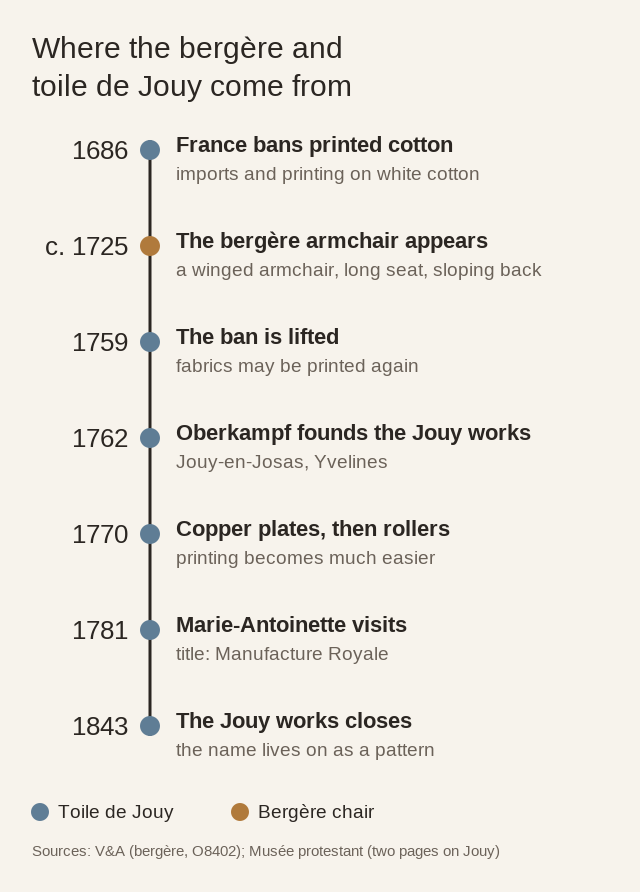
- A bergère or other upholstered armchair. The Victoria and Albert Museum describes the bergère as "a new form of winged armchair that was developed in France in about 1725," designed to be comfortable, "with a long seat and a sloping back" (V&A). One of these in linen next to a plain sofa does more for the room than a matching set.
- Cabriole legs, the S-curved leg on chairs, side tables and dressers. One or two pieces with them are enough; on every piece they turn fussy.
- Cane backs and rush seats. They lighten a dining set, and to my eye cane and rush look better slightly worn.
- An armoire or a tall cupboard. In an American house it can hide a TV, a bar or coats and still read as an old piece.
- A farmhouse table with mismatched chairs. A bench on one side, two different chair styles on the other, all in related wood tones.
Vintage or new? My rule of thumb: buy old where age shows best (wood case pieces such as armoires, dressers and tables, where real wear can't be faked well) and new where comfort matters (sofas and upholstered chairs, where old springs and stuffing are a gamble). A new upholstered chair with a French shape and a linen slipcover is a perfectly honest choice.
Fabrics and Patterns: Linen, Check, Ticking, Toile
The default fabric is linen, slightly rumpled, in white, oatmeal or gray. Benji Lewis suggests "textures like linen and hemp and simple patterns like checks or ticking stripes," and toile with a pastoral scene on walls or as curtains (Homes & Gardens).
Toile de Jouy is the pattern most people mean when they say "French." It is named after Jouy-en-Josas in the Yvelines department, where Christophe-Philippe Oberkampf founded a cotton printing works in 1762, three years after France lifted a ban on printed cotton that had stood since 1686 (Musée protestant). The works printed in red, blue, green or gray, with figures and pastoral or antique scenes; from 1770 copper plates, and later engraved rollers, made printing much easier and allowed continuous production (Musée protestant, Les Toiles de Jouy). Queen Marie-Antoinette visited in 1781, the factory was granted the name Manufacture Royale, and it closed in 1843. To my eye, that engraved origin is why classic toile reads like a fine drawing rather than a painting.
How many patterns per room? My rule of thumb is three at most: one large (toile or a floral), one small (a check), one stripe (ticking), all sharing a color. Plain linen fills the rest. Toile works best in one generous place, such as curtains, a headboard or one armchair, rather than on every cushion.
Curtains hang from a plain iron or wooden rod set well above the frame, in linen or cotton that breaks just at the floor or puddles slightly. To my eye, sheer linen on its own suits the style better than heavy lined drapes. Panel fullness and how far the rod should reach past the frame are in our bedroom curtains guide.
Lighting: Wood, Iron and Warm Bulbs
The classic ceiling light is a chandelier in carved wood or simple iron, sometimes with small linen shades. Table lamps have ceramic or turned-wood bases with pleated or plain linen shades. Candle lanterns on a table or mantel finish the picture.
Two practical points. Hang a chandelier over a table rather than in the middle of the ceiling, because the style is built around gathering places. And use warm bulbs everywhere; to my eye, cool white light tends to make chalky walls look gray and flat. Our kitchen lighting guide explains color temperature and how high to hang a fixture over a table or island.
Display: Pottery, Plates and Found Pieces
French country rooms show the things that were used: stoneware crocks, a stack of plates, copper pans, glass bottles, baskets. Group them by material or color on open shelves or a hutch instead of spreading single objects around the room. Our guide to decorating shelves explains how much to put on a shelf and how much to leave empty.
Plates on the wall are a signature detail. Use wire or adhesive plate hangers made for the plate's diameter, hang the heaviest plates lowest, and screw into a stud or a wall anchor rated for the weight instead of a single nail. Lay the arrangement out on the floor first and keep the gaps roughly even.
Room by Room
Living room. Start with the shell: warm off-white walls, a wood or terracotta-toned floor, a flat-woven rug. Add a linen sofa, one bergère or cane-backed chair, a wooden coffee table with some wear, an iron or wood lamp, and toile on one item. A mantel with a pair of old candlesticks and a mirror in a carved or gilded frame finishes it.
Kitchen. The style reaches its fullest form here: open shelves or a plate rack, a farmhouse sink, a mix of painted and wood cabinets, terracotta or stone tones, copper and stoneware on show. Our French provincial kitchen guide goes into cabinetry, backsplashes and layout, and our kitchen paint colors guide covers the wall and cabinet colors.
Bedroom. An iron bed or a wooden bed with a curved or upholstered headboard, white linen bedding, a quilt or a ticking-stripe throw, and toile curtains or one toile wall behind the bed. A painted chest of drawers with cabriole legs replaces a matching nightstand set. Our bedroom paint colors guide explains how warm bedside bulbs shift whites and blues.
Dining room. The farmhouse table with mismatched chairs, a wood or iron chandelier hung low over the table, linen napkins, and plates or landscape prints on the walls. How wide the art should be and how high to hang it above a sideboard are in our guide to wall art for the dining room.
Mixing French Country with What You Already Own
You probably come to this style with furniture already in the house. The workable approach is to keep the shell French country and let the existing pieces stand in it.
| What you have | What bridges it to French country |
|---|---|
| Modern sofa, clean lines | a linen or cotton slipcover, one bergère beside it, a worn wood side table |
| Farmhouse pieces (shiplap, white paint, galvanized metal) | swap galvanized metal for iron or copper, add one curved-leg piece, replace buffalo check with ticking or toile |
| Mid-century wood furniture | keep the warm walnut or teak, which matches the wood palette; add linen, stoneware and one cane chair |
| Glossy or lacquered pieces | the hardest fit; move them to another room, or keep one and surround it with matte textures |
An old wooden table is usually the piece that ties a mixed room together: once it is there, modern chairs around it look chosen instead of left over. Our guides to modern farmhouse cottage decor and English country cottage interiors show the neighboring styles if your room leans that way.
Budget: Where It Costs and Where It Doesn't
In my view, French country is one of the cheaper styles to get right, because its raw materials are old, plain and often secondhand. Where the money goes, as my own rules of thumb rather than price research:
- Cheap: paint in a warm off-white, linen-look curtains, stoneware and plates from thrift and antique shops, ticking-stripe cushion covers, baskets.
- Worth paying for: one good upholstered chair, one solid wood case piece (an armoire, a dresser or a table), and real linen bedding, which softens with washing.
- Expensive and optional: terracotta or stone floors, real plaster walls, structural beams. They make the strongest version of the style, and a room can read as French country without any of them.
Benji Lewis's advice in Homes & Gardens is to source from local "brocantes," French secondhand markets; the American versions are flea markets, estate sales and antique malls.
Patina: Real Wear Versus Sanded-On Distressing
The style depends on wear, and wear is easy to fake badly. My rule of thumb: real age shows where hands and feet actually touch a piece: the edges of a tabletop, the lower rail of a chair, the area around a drawer pull, the top of a step stool. Sanded-on distressing is often even, all over, and on the corners nobody touches.
If you paint a piece yourself, rub back the paint only where it would wear naturally, and use a wax or matte finish instead of a gloss varnish. Better still, buy one genuinely old piece and let the newer ones stay plain. Beside real patina, fake patina tends to show, while simple new furniture looks fine.
Where It Tends to Slip, and the Fix
- Too much theme. Roosters, lavender and fleur-de-lis on everything. Keep one motif, or none; the materials carry the style.
- Everything matched. A full French-style furniture set from one store. Swap two pieces for different woods or a painted finish.
- Colors too bright. Saturated yellow and cobalt. Fade them toward ochre and gray-blue.
- All new, all smooth. Add one old wood piece, linen and stoneware; texture does more than color.
- Too many patterns. Limit them to three that share a color, with plain linen between them.
Next Step
Start with the shell. Paint the walls a warm, matte white, then add the one piece the room is missing, usually a wooden table or a curved chair. For the wider family this style belongs to, browse our Cottage & Farmhouse styles, and for the kitchen, go on to the French provincial kitchen guide.
Sources read for this guide: Homes & Gardens, guide to rural French homes (Camille Dubuis-Welch, 2024) · Victoria and Albert Museum, bergère chair · Musée protestant, Printed fabrics in Jouy-en-Josas · Musée protestant, Les Toiles de Jouy.


