
The short answer: size the rug to the bed, not the room. A queen takes an 8 × 10, a king or California king a 9 × 12, a full an 8 × 10 (a 6 × 9 is tight), and a twin a 5 × 8. Aim for at least 18 inches of rug beside each side of the bed, so both feet land on it when you get up. For bare feet, pick medium to high pile in wool or a dense synthetic, and put a rubber or felt-and-rubber pad under it on a hard floor.
That sounds simple, and the sizes really are the easy part. Where people go wrong is the placement (a rug that floats at the foot of the bed and catches nobody's feet) and the fiber (a scratchy jute that looks lovely and feels like a doormat at 6 a.m.). This guide follows the order of the decisions: size, placement, pile and fiber, pad, color by style, care.
What Size Rug for Each Bed
The rule designers repeat is that the rug should be wider than the bed. In Homes & Gardens, designer Rayana Schmitz recommends an 8 × 10 for a queen and a 9 × 12 for a king, and designer Eddie Rider uses a 9 × 12 or a 10 × 14 under a king. The table below runs the numbers for every bed size, using standard mattress dimensions and the rug laid lengthwise from the headboard wall.
| Bed (mattress) | Rug | Rug at each side | Rug past the foot |
|---|---|---|---|
| Twin (38 × 75 in) | 5 × 8 ft | 11 in | 21 in |
| Twin, roomier | 6 × 9 ft | 17 in | 33 in |
| Full (54 × 75 in) | 6 × 9 ft | 9 in | 33 in |
| Full, recommended | 8 × 10 ft | 21 in | 45 in |
| Queen (60 × 80 in) | 8 × 10 ft | 18 in | 40 in |
| Queen, larger room | 9 × 12 ft | 24 in | 64 in |
| King (76 × 80 in) | 9 × 12 ft | 16 in | 64 in |
| King, large room | 10 × 14 ft | 22 in | 88 in |
| California king (72 × 84 in) | 9 × 12 ft | 18 in | 60 in |
Two things stand out. A full bed on a 6 × 9 leaves only 9 inches at each side, so one step and you're on the bare floor; the 8 × 10 is the better fit if the room allows it. And an 8 × 10 under a king leaves just 10 inches per side, which is why the king starts at 9 × 12.
My rule of thumb is 18 inches or more at each side, because that's roughly where your feet land when you swing them out of bed. If your room is an odd shape or the bed sits off-center, the rug size calculator draws your bed on each standard size to scale and shows the exact margin.
Three Ways to Place It
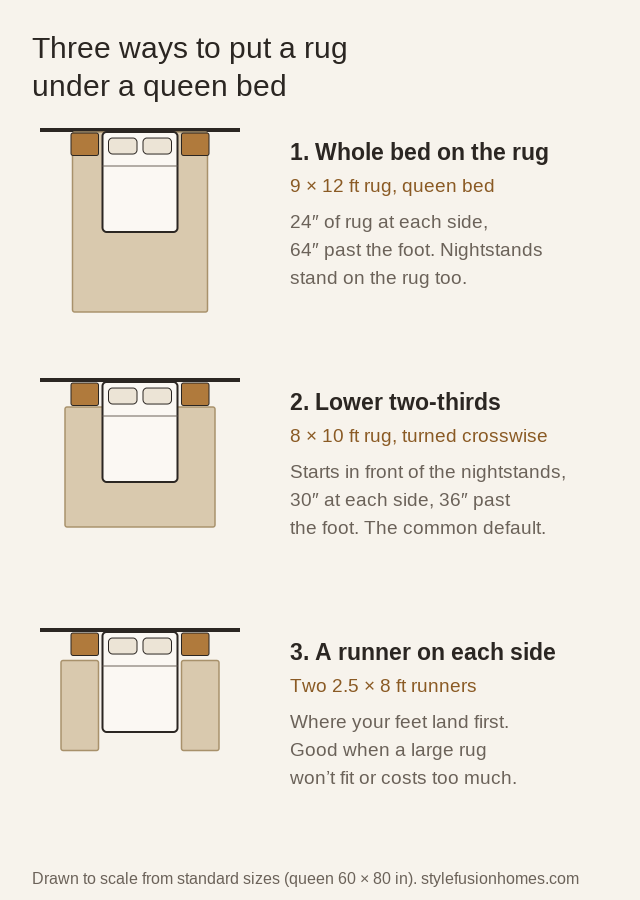
1. The whole bed on the rug. The rug runs from the headboard wall past the foot, and the nightstands stand on it too. This looks the most anchored and needs the biggest rug: a 9 × 12 for a queen. It suits large rooms with the bed against the middle of a wall.
2. The lower two-thirds. The most common layout. Turn an 8 × 10 crosswise and start it just in front of the nightstands, so they stay level on the bare floor. Schmitz describes starting the rug about 6 to 12 inches from the nightstand. Under a queen, that leaves 30 inches at each side and about 36 inches past the foot, which is enough for a bench.
3. A runner on each side. Two runners, typically 2.5 × 8 feet, along the long sides of the bed. They cover exactly the spots where you step and cost far less than one large rug. They work well in a small room, or when the bed sits against one wall (then you only need one). Nourison points out that runners beside the bed take the most concentrated foot traffic, so a durable, low-shedding fiber matters more here than on a large rug.
A rug only at the foot of the bed is the layout I'd skip: your feet land beside the bed, not at the end of it, so it decorates without doing the job.
Pile Height and Fiber for Bare Feet
 Erstellt mit AI
Pile height is how tall the fibers stand above the backing. Nourison's reference points: low pile is about 1/4 inch or less, medium roughly 1/4 to 1/2 inch, and high pile anything above that (Nourison). For bedrooms it recommends medium to high, because traffic is light and comfort counts; medium is the starting point if you want easier vacuuming.
Two cases call for low pile anyway: a door that swings across the rug, and a rug that has to carry a heavy bed frame without the legs sinking in and leaving dents.
| Fiber | Feel underfoot | Good to know |
|---|---|---|
| Wool | soft, springy, warm | the classic choice; can shed for the first weeks |
| Cotton (flat-woven) | thin, smooth | often washable; slides without a pad |
| Jute or sisal | firm, coarse | handsome, but scratchy for bare feet; better for a living room |
| Polyester, nylon | soft, especially at high pile | easier on the budget; nylon is the hard-wearing one |
| Faux fur, shag | very soft | most vacuuming; sheds lint |
If you love the look of a natural-fiber rug, a common compromise is to layer: a large jute or sisal rug for the size, and a smaller soft rug or sheepskin on top where your feet land.
A Pad Stops the Slide
On a hard floor, a bedroom rug creeps every time you push off it getting into bed. The fix is a pad cut slightly smaller than the rug, so its edge stays hidden. Rubber grips best; felt alone cushions but barely holds; a felt-and-rubber combination does both. For a thin flat-woven or cotton rug, the pad is what makes it feel like a rug at all.
On wall-to-wall carpet, choose a pad made for rug-on-carpet use, and pick a low-pile or flat-woven rug; a thick pile rug over carpet tends to wrinkle and walk. Check that the bedroom door still clears both layers.
Color and Pattern by Style
A bedroom rug is a large surface you look at from bed, so it sets more of the mood than the throw pillows do. A few pairings that work with the styles on this site:
- Modern farmhouse or cottage: cream, oatmeal or a faded stripe; a flat-woven cotton or a low wool pile. Our modern farmhouse bedroom guide shows the rest of the room.
- Coastal: sand, white, soft blue; jute or a jute-look synthetic under a soft layer. See the coastal bedroom guide.
- Traditional or vintage: a faded Persian or Oriental-style pattern in rust, navy or rose, which also hides wear.
- Minimal or Scandinavian: ivory, gray or warm white with texture instead of pattern.
- Boho or eclectic: a kilim or a patterned wool in terracotta and ochre, with plain bedding so the room doesn't get busy.
My rule of thumb: if the bedding is patterned, keep the rug plain, and the other way around. And look at the rug next to your wall color in daylight before you commit; our bedroom paint colors guide covers the walls side of that pairing.
Care: Vacuuming, Washing, Rotating
A bedroom rug collects less grit than a living room rug, but more dust and lint, especially near the bed. Vacuum it on the same day as the rest of the floor, and more often with pets or allergies, paying attention to the strip along the bed where lint collects. Turn it end for end now and then, so the side by the window doesn't fade on its own. Only put a rug in the washing machine if its label says it's machine-washable.
One safety point, because bedrooms are where space heaters end up in winter: the U.S. Consumer Product Safety Commission advises keeping all sides of a heater at least 3 feet from beds, curtains and other things that can burn, and never running the heater's cord under a rug (CPSC, portable heater safety). A cord under a rug gets walked on, wears unseen and can overheat.
Next Step
Measure the bed (frame, not mattress, if the frame is wider) and the free floor at each side, then check the table above or let the rug size calculator draw it. Once the rug is down, the bedroom curtains guide is the natural next piece, since curtains and rug are the two big soft surfaces in the room.
Sources read for this guide: Homes & Gardens, bedroom rug placement rules (Sarah Warwick, 2024) · Nourison, the best rug pile for each room (2026) · U.S. Consumer Product Safety Commission, portable heater safety. Rug margins in the table and the infographic are my own calculations from standard mattress and rug sizes.


